Home›Blog ›9-Inch vs. 12-Inch Image Intensifier: Why Tube Size Alone Is the Wrong Way to Choose a Replacement
9-Inch vs. 12-Inch Image Intensifier: Why Tube Size Alone Is the Wrong Way to Choose a Replacement
When a C-arm loses brightness or contrast and the tube has to be replaced, the first question in most procurement emails is simple: “Should we go with a 9-inch or a 12-inch image intensifier?”
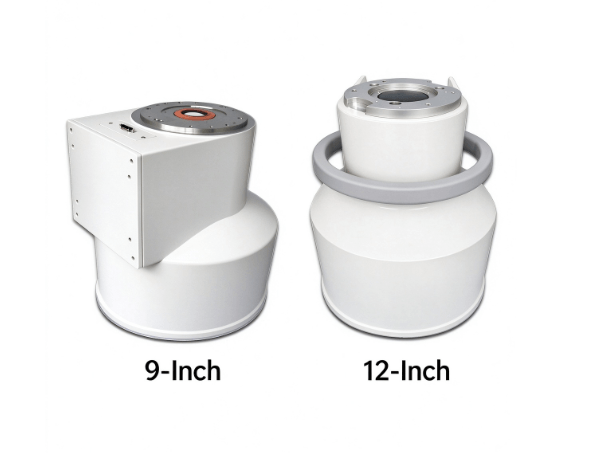
It sounds like the right question. In practice, it is the wrong one — and starting there is how buyers end up with a tube that will not fit their housing, will not couple to their existing camera, or delivers a wider field of view at the cost of the image quality they actually needed.
This guide explains what really determines the correct tube for your system, and gives you a five-minute checklist to run before you request a quotation.
Why “bigger is better” fails here
An image intensifier is not a standalone part you can upsize freely. The tube lives inside a housing that provides lead shielding against x-ray leakage, mu-metal shielding against external magnetic fields, and a fixed mechanical interface: mounting flange, overall length, and output window position.
A 9-inch (230 mm) tube and a 12-inch (310 mm) tube have different overall lengths, different mounting surfaces, and different output image diameters — typically 19–22 mm versus 21–25 mm. A 12-inch tube cannot be dropped into a 9-inch housing, and the reverse is equally true.
Size is therefore a downstream decision. It is set by three things you already own: the housing, the optics/camera chain, and the clinical workload.
The five factors that should decide the tube
1. Housing compatibility — the hard constraint. Identify the housing model and flange position first. If your existing housing is a 9-inch unit, the replacement is a 9-inch tube, full stop. Size becomes a choice only when you are specifying a new system or replacing the housing as well.
2. Field of view versus resolution — the real trade-off. A 9-inch tube covers roughly a 215 mm useful input field; a 12-inch tube covers about 300 mm. The larger field lets you image a full lumbar spine or a peripheral run in a single shot. But resolution falls as field size grows: central resolution that is comfortably above 40 lp/cm on a good 9-inch tube drops noticeably on a 12-inch tube, and edge distortion increases with distance from the center. For extremity work, pain management, and routine orthopedic fixation, a 9-inch field is usually sufficient and sharper.
3. Dose behaviour in magnification mode. Every tube offers magnification modes by electrically narrowing the input field — a 12-inch tube typically offers 12/9/6-inch modes, a 9-inch tube 9/6/4.5-inch. Magnifying concentrates the beam on a smaller area, so the automatic brightness control raises output to keep the image bright. In mag mode, dose per unit area of skin rises. If most of your procedures are already performed in a magnified mode, buying a larger tube does not buy you lower dose — it buys you a wider normal-mode field you may rarely use.
4. Camera and optics coupling. The output image diameter must match your lens and CCD/CMOS camera. A larger output diameter can require re-shimming or a different lens. Confirm this before ordering; it is the most common surprise during retrofit.
5. Power supply and anode voltage. Check the anode voltage and focusing electrode voltage range your generator supplies. Tubes from different manufacturers are broadly compatible in the 25–35 kV range, but the connector pinout and the ion pump supply are not universal.
9-inch vs 12-inch at a glance
| Criterion | 9-inch (230 mm) | 12-inch (310 mm) |
| Useful input field | ~215 mm | ~300 mm |
| Typical applications | Mobile C-arms, orthopedics, urology, pain management | Peripheral angiography, large-area fluoroscopy |
| Central resolution | Higher | Lower |
| Edge distortion | Moderate | More pronounced |
| System footprint | Compact, easier gantry angulation | Bulkier, limits extreme angles |
| Magnification modes | 9 / 6 / 4.5-inch | 12 / 9 / 6-inch |
| Weight | Lighter | Heavier |
A 5-minute checklist before you request a quote
- Photograph the housing nameplate — model number, and the tube’s overall length.
- Record the output image diameter and camera/lens model.
- Note the generator’s anode voltage and ion pump connector type.
- List the top three procedures performed on the unit, and the field of view each needs.
- Note whether the system will be retained 3+ years — if it will be retired soon, a re-tubed 9-inch unit is the economical route.
Send those five items with your inquiry and a supplier can confirm the right tube in one reply instead of three rounds of emails.
When a 12-inch tube is genuinely the right call
Choose 12 inches only if your workload is dominated by large-area imaging — peripheral vascular runs, full-spine work, or wide-field fluoroscopy tables — and if your housing, camera chain, and room layout already support the larger tube. Otherwise, a 9-inch tube gives sharper images at a lower price, with lower weight and no re-engineering.
Frequently asked questions
Can I replace a 9-inch tube with a 12-inch tube for a wider view? No. The housing, mounting flange, overall length and output window differ. A wider field requires a 12-inch housing and matched camera optics.
Does a 12-inch intensifier always mean a higher radiation dose? Not in normal mode, but in magnification mode the automatic brightness control increases output to maintain brightness. Large-field tubes are chosen for coverage, not for dose savings.
How do I know my current tube is 9-inch or 12-inch? Measure the useful diameter of the input screen (about 215 mm = 9-inch, about 300 mm = 12-inch) or read the model number on the housing nameplate.
Ready to confirm your replacement?
We supply 6-inch, 9-inch and 12-inch image intensifiers as direct replacements for major C-arm brands, with matching housings and CCD camera options. Send us your housing model and the five checklist items above, and our engineers will confirm the correct tube — usually within one working day.
- [9-inch image intensifier tubes →] (product page link)
- [12-inch image intensifier tubes →] (product page link)
- WhatsApp: +86 19015366638 · Email: newheekcn@163.com
Author:Image Intensifier
Product Category
News
- 9-Inch vs. 12-Inch Image Intensifier: Why Tube Size Alone Is the Wrong Way to Choose a Replacement
- Is Your C-Arm Image Intensifier Actually Failing? 6 Symptoms That Point to Replacement (and 3 That Don’t)
- output phosphor of image intensifier
- Image Intensifier Market
- Compatible X-ray II High Tension Power Unit
Contact us
Tel: +86 19015366638
Whatsapp: +86 19015366638
Email: newheekcn@163.com
Company: Weifang Newheek Electronic Technology Co., Ltd.
ADD: E Building of Future Star Scientific Innovation Industrial Zone of No.957 Wolong East Street, Yulong Community, Xincheng Sub-District Office, Weifang Hi-tech Zone, Shandong Province, China